The world’s two massive ice sheets — in Greenland and Antarctica — are melting at a pace that threatens to trigger devastating sea level rise, according to a new study that casts doubt on even the most ambitious climate targets.
International researchers have concluded there may be no “safe” threshold for global warming that would guarantee the survival of the planet’s ice sheets. Their work, drawing on satellite data, climate models, ancient ice cores, and even octopus DNA, paints a grim picture: even keeping global warming to 1.5 degrees Celsius above pre-industrial levels, the long-standing goal of world leaders, may not be enough to avert disaster.
Currently, the world is on a trajectory toward nearly double that amount — up to 2.9 degrees Celsius of warming by the end of the century. Yet the study, published in Communications Earth and Environment, finds that the melting trend may be locked in even at today’s warming of 1.2 degrees.
Both the Greenland and Antarctic ice sheets together hold enough water to raise sea levels by about 213 feet — a worst-case scenario that is highly unlikely, but underscores the massive risk. Already, the amount of ice lost each year has quadrupled since the 1990s, and they are now losing around 370 billion tons annually. This melting is now the leading factor in global sea level rise, which itself has doubled in pace over the last three decades.
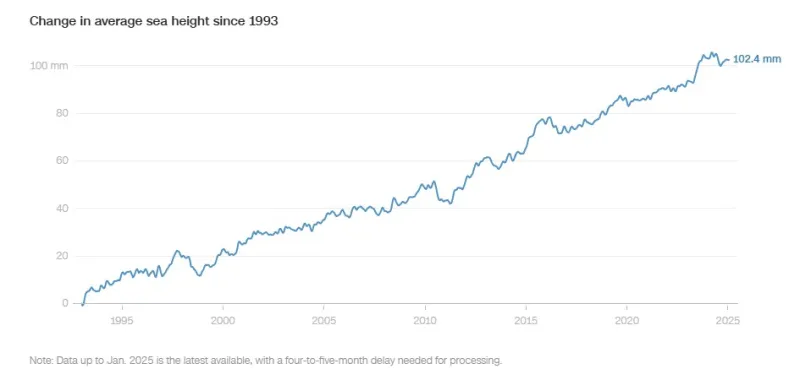
NASA explains that the main causes of rising seas are meltwater from ice sheets and glaciers, along with the expansion of warming seawater. Since 1993, average global sea level has increased by four inches, and the trend is only accelerating.
“You don’t slow sea level rise at 1.5, in fact, you see quite a rapid acceleration,” said Chris Stokes, glaciologist at Durham University and a co-author of the study. The world should brace for several feet of sea level rise in the coming centuries, even under best-case scenarios, the researchers warn.
Currently, about 230 million people worldwide live less than a meter above sea level. Even small reductions in the world’s ice sheets will force massive migrations and pose adaptation challenges for governments and societies everywhere.
By the end of the century, seas could rise as much as 0.4 inches per year, adding up to nearly a meter (about 40 inches) every hundred years — a pace that would overwhelm coastlines and spark migration on a scale not seen in modern history. “You’re going to see massive land migration on scales that we’ve never witnessed since modern civilization,” said Jonathan Bamber, glaciologist at the University of Bristol and a study co-author.
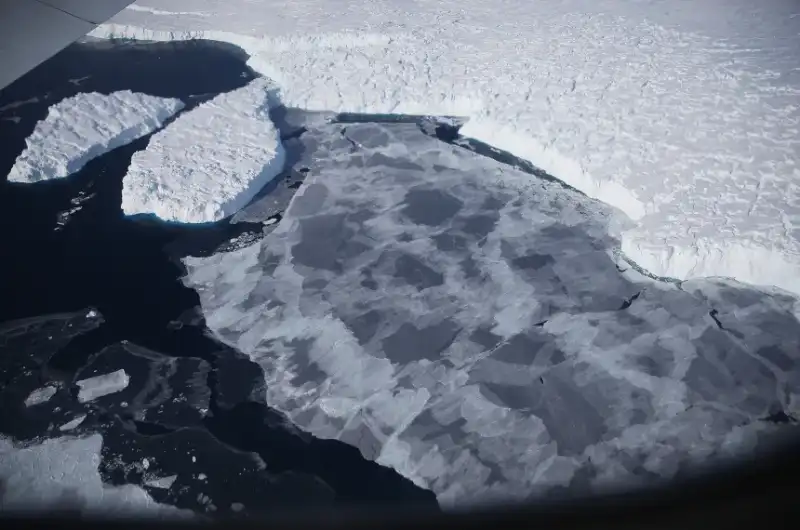
Complicating matters is the uncertainty about when and where “tipping points” will be crossed. Early estimates suggested it would take about 3 degrees of warming to destabilize the Greenland ice sheet, but newer data points to the possibility of collapse at around 1.5 degrees or even lower.
According to the scientists, limiting warming to closer to 1 degree Celsius above pre-industrial levels is likely needed to prevent rapid, irreversible ice sheet loss. Achieving this would require deep, immediate cuts in fossil fuel use — something that appears unlikely as major economies continue to invest in oil, coal, and gas.
“There’s very little that we’re observing that gives us hope here,” Stokes said. The “best-case scenario is that sea level rise is slow and steady,” but every fraction of a degree of additional warming increases the risks and consequences.
For now, the study’s authors urge that the world not abandon climate targets — as every action that limits warming will help. “Limiting warming to 1.5 will be a major achievement. It should absolutely be our target, but in no sense will it slow or stop sea level rise and melting ice sheets,” Stokes emphasized.